




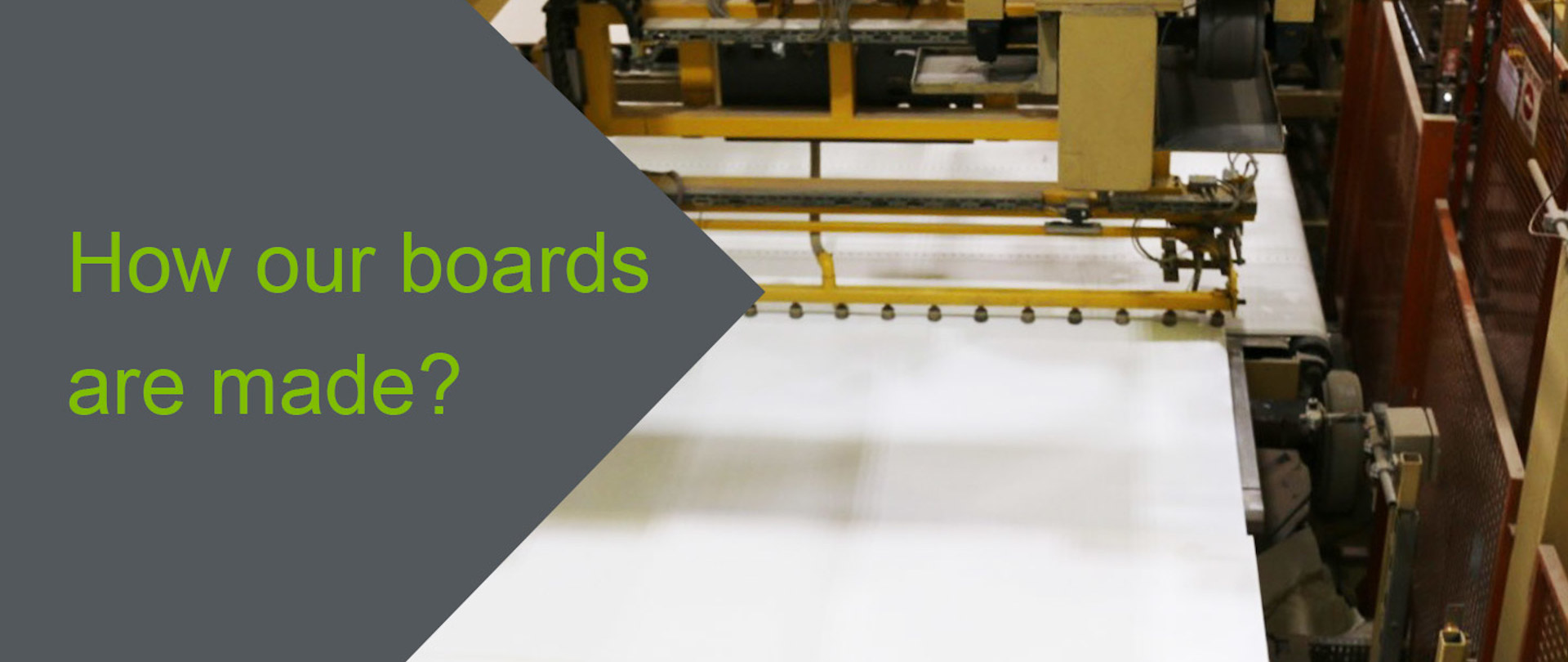
At Sonae Arauco, we pride ourselves in producing the best quality wood-based panels. Our sustainable outlook and manufacturing expertise ensure that our boards and manufacturing processes are held to the highest standard.
We manufacture two different types of board substrates, namely Particleboard and Medium Density Fibreboard and our board-making process is something that we have fine-tuned to perfection over the years.
- Our boards start off as sustainable timber (pine and eucalyptus). Once the trees have been felled, round logs and offcuts are chipped and then combined with sawmill waste, which is a mixture of wood chips and sawdust.
a. The manufacturing of Medium Density Fibreboard differs from Particleboard in that wood fibres rather than wood particles are used to form the board. This is achieved by softening wood chips through a refining process in order to form a wood fibre pulp that is lightweight, finely textured and fluffy in appearance.
b. The wood fibre pulp is then pressed and forms a distinctive homogeneous substrate characterised by its extremely smooth surface and creating a board that is higher in density and weighs more than Particleboard. - The combined mixture of chips and sawmill waste is then prepared in order to make it suitable for the board manufacturing process which occurs later in the process. Two types of preparation occur, namely:
a. Wet preparation – which sees the material pass through flakers in order to ensure that they are the correct size and that they achieve optimal chip geometry.
b. Dry preparation – the material is then fed into a dryer in order to remove any remaining moisture. The material then passes through a series of screens which separates it into finer and coarser materials; with the over-sized material being reworked and refined to the correct size, and then re-screened. - Once screening has been completed, our blend of synthetic resins are then blended into the refined material at the glue deck.
- Once the material and resins have been combined, the mixture then moves to the forming line where machinery called spreaders lay it out onto a moving mat in order to form the ‘cake’. The cake is made up of a three-layer profile, namely SL (fine material) -CL (coarse material)- SL (fine material). The three-layer profile which is characteristic of particleboard is as a result of the combination of the screened fine and coarse material.
- The three-layer ‘cake’ is then transported via a moving belt to the press where it is bonded together by using heat and pressure.
- The pressed board then exits the press and passes through a scale and blister detector, which ensures that the board meets the requirements of being 16mm, produced to within a 0.6mm tolerance.
- The board is then automatically stacked in the star coolers, where it is allowed to cool (cure).
- Once completely cooled, the board is then sanded to achieve the high-quality smooth surface which Sonae Arauco is known for. When the board exits the press approximately 0.6mm has been sanded.
- Once sanding has been completed, the board passes through a system of saws which cut the board into predefined panel sizes.
- In order to create melamine boards, printed paper is then impregnated with a melamine resin, after which it is bonded to either the Particleboard or Medium Density Fibreboard through a combination of heat and pressure.
- The printed paper which is bonded to the Particleboard or Medium Density Fibreboard is known as the ‘fashion product’, as it is printed with photographic digital designs (such as wood structures, solids, etc), combined with variations in colour, and finishes (embossed effect).
For more information about our Melamine Boards, contact us on (+27) 11 236 1400.
Read more on our previous article here.